As of October 24, 2026, AI-generated videos that paste the faces of business leaders and celebrities onto the dance video for 'NEON,' the debut song by rookie girl group A2O LITE, are spreading as a meme on Korean social media. All it takes is one photo and a short source clip, so the trend moves fast, but worries about likeness and copyright are growing, and the government says it will amend laws to regulate digital replicas.
Key points
- A2O LITE debuted on the 13th of this month, and AI-swapped parodies of its debut song 'NEON' choreography video are flooding the internet.
- The best-known tool is Genjutsu, launched by Higgsfield in late August, which swaps the person while keeping the original dance moves and camera movement.
- Critics say faces are being used without consent and that the work of the original creators is being undermined.
- On Oct. 14, Korea's Intellectual Property Office said it would clearly bring AI-recreated faces and voices under the Unfair Competition Prevention Act and set a basis for criminal penalties for unauthorized commercial use.
The trend started with 'NEON' by A2O LITE, a multinational girl group that debuted on the 13th of this month. The song, released by A2O Entertainment under producer Lee Soo-man, hit the top of Korea's music charts right after release. Its hook, 'Neon and beyond,' sounds like 'mihon-aen-bihon' (roughly, 'unmarried and unmarried') when read with Korean pronunciation, and the parody videos picked up that name.
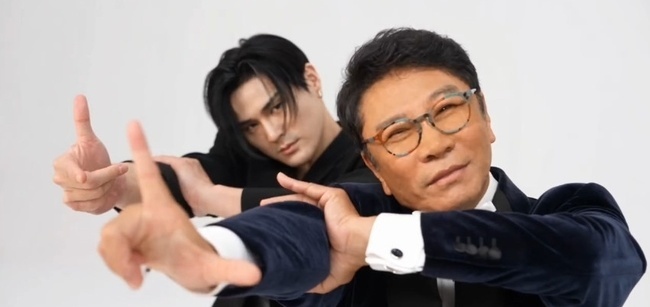
The swapped videos feature everyone from Samsung Electronics Chairman Lee Jae-yong and SK Group Chairman Chey Tae-won to agency producers, TV personalities, pets and cartoon characters. Sunny of Girls' Generation posted her own version featuring producers Lee Soo-man and Yoo Young-jin, and it passed 8 million views. Overseas, a video of Nvidia CEO Jensen Huang re-creating a Michael Jackson stage performance came out on the 4th and racked up around 6 million views on Chinese platform Bilibili alone. Tesla CEO Elon Musk shared it with a joke about memory prices.
The go-to tool for these clips is Higgsfield's Genjutsu. Users upload a source video of up to 30 seconds plus a photo of a person, pick a feature, and the cast, outfits and background change while the dance moves and camera work stay put. A 15-second video costs a little over $5, so people with no editing skills can easily copy the trend. Some hospitals and small businesses have also been spotted using similar swapped videos for promotion on social media.
The problem is that this ease of use comes with side effects. Romain Gavras, who directed the music video 'Storm,' told media outlet Vulture he felt sad when person-swapped copies of the video started circulating, after he'd spent two months preparing 66 dancers and shooting multiple takes. He added that the trend could make even good work look frivolous. Consent from the people being swapped in is another issue. In August, TV personality Lee Ji-hye said she would take legal action after fake food ads using her face spread online.
Rules are starting to catch up. On Oct. 14, Korea's Intellectual Property Office announced it would handle digital replicas such as AI-made faces and voices under the Unfair Competition Prevention Act and create grounds for criminal penalties for unauthorized commercial use. Kim Yong-sun, the agency's head, said enforcement matters as much as the rules themselves and promised to build an enforcement system suited to the AI era.
FAQ
What is the 'Mihon-aen-bihon Challenge'?
It's a nickname taken from the Korean pronunciation of the lyric 'Neon and beyond' in A2O LITE's debut song 'NEON.' It refers to parody videos in which AI swaps the people in the original dance video with other people or characters.
How are these videos made?
You upload a source video of up to 30 seconds and a photo of a person to a tool like Higgsfield's Genjutsu. It outputs a video with the dance moves and camera movement intact but a different person on screen. A 15-second video reportedly costs about $5.
Are there legal issues in Korea?
Swapping in someone's face without their consent raises likeness-rights concerns. On Oct. 14, Korea's Intellectual Property Office said it would clearly include digital replicas under the Unfair Competition Prevention Act and add a basis for criminal penalties for unauthorized commercial use. The amendment has not been completed yet.
More from Korea today
BTS' 'Swim' Hits 1B Spotify Streams, a 2026 First →IVE's Liz Gets a Surprise Call From Mom on Food Show →
📎 원문 보기 · Sources


재경일보 · Oct 19, 2026이재용·최태원 춤추는 AI 합성 영상 SNS서 확산Read the full story & photos at the source →
 아이뉴스24 · Oct 16, 2026이재용·최태원도 춤춘다?…공개 사흘 만에 화제 된 'K팝 영상'Read the full story & photos at the source →
¡°ÀÌ°Ô µöÆäÀÌÅ©, ±â±«ÇÏ´Ù¡± À̼ö¸¸ °É±×·ì ¡®¹ÌÈ¥¾ØºñÈ¥¡¯ AI 縰Áö¡¦¾ù°¥¸° ½Ã¼± - ¼Õ¿¡ ÀâÈ÷´Â ´º½º ´«¿¡ º¸ÀÌ´Â ´º½º - ´º½º¿£ · Oct 20, 2026¡°ÀÌ°Ô µöÆäÀÌÅ©, ±â±«ÇÏ´Ù¡± À̼ö¸¸ °É±×·ì ¡®¹ÌÈ¥¾ØºñÈ¥¡¯ AI 縰Áö¡¦¾ù°¥¸° ½Ã¼±Read the full story & photos at the source →
Leave a Reply